


A practical guide with helpful links to the Colorado rules, local wage pages, and recent cases. Colorado employment law continues to evolve. Here are some highlights of employment practices to review.
At a glance
- Check pay by work location, not just by headquarters or mailing address.
- Keep overtime, non-compete, and contractor analyses separate.
- Update healthcare covenants, leave policies, and biometric practices for 2026.
- Revisit manager decisions that change schedule, role, or working conditions.
1. Minimum wage now depends on where the work happens
For many employers, wage compliance no longer starts and ends with the statewide rate in Colorado's 2026 PAY CALC Order. In 2026, Denver, the City of Boulder, unincorporated Boulder County, and Edgewater all sit above the statewide minimum.
2026 minimum wage snapshot
Jurisdiction | Standard wage | Tipped cash wage* |
Denver | $19.29 | $16.27 |
Edgewater | $18.17 | $13.50 |
City of Boulder | $16.82 | $13.80 |
Unincorporated Boulder County | $16.82 | $13.80 |
Colorado statewide | $15.16 | $12.14 |
* The tipped cash wage assumes the employer can lawfully take the available tip credit.
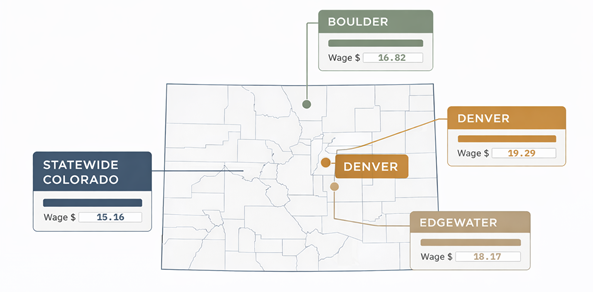
Start with a map of where employees actually work each week. Then confirm that payroll is set up for the right jurisdiction, not just the right employer entity.
2. Exempt from overtime does not mean covered by a non-compete
The salary floor for Colorado's executive, administrative, and professional overtime exemption is $57,784 per year in 2026 under the PAY CALC Order. The pay threshold for most enforceable non-competes is much higher: $130,014.
Those are different tests serving different purposes. A manager earning $95,000 may be properly exempt from overtime and still sit below the non-compete threshold. That is where old offer letters, recycled covenant language, and boilerplate separation papers create trouble.
Treat wage-and-hour classification and restrictive-covenant review as two separate projects. One does not answer the other.
3. Contractor classification got more expensive
Colorado also raised the stakes on misclassification. House Bill 25-1001 increased the penalty risk for willful violations. First violations can reach $5,000 per worker, and repeat or uncorrected violations can reach $50,000 in some cases.
A proper analysis and agreement for independent contract workers, is now more important.
4. Healthcare non-competes are narrower than many old forms assume
Senate Bill 25-083 changed Colorado's restrictive-covenant law for physicians, advanced practice registered nurses, and dentists. The usual highly compensated employee exception no longer saves a covenant that restricts the practice of medicine, APRN, or dentistry in Colorado.

The same bill also bars terms that prevent a departing provider from telling existing patients that the provider is leaving, how the provider can be reached, or that the patient may choose another provider.
That makes older forms risky. In this part of the statute, a high salary no longer answers the enforceability question.
5. Minority-owner restrictions need a fresh calculation
The same SB 25-083 also changed the sale-of-business exception for some minority owners. If the seller owns less than 50% and received that interest as compensation for services, the length of an enforceable covenant now turns on a statutory formula tied to sale proceeds and recent compensation.
That means a standard two-year or three-year restriction may overshoot the statute even if it once looked ordinary. Buy-sell agreements, rollover equity documents, and separation papers should be checked against the current formula.
6. FAMLI expanded for NICU leave
Beginning January 1, 2026, Colorado's FAMLI program gives eligible parents up to an additional 12 weeks of leave when a child is receiving inpatient care in a neonatal intensive care unit. Senate Bill 25-144 also set the 2026 premium rate at 0.88% of wages.
That change affects more than the leave policy itself. Employers should update notices, train supervisors, and make sure payroll deductions match the 2026 rate.
7. Mandatory political or religious meetings now carry more risk
House Bill 24-1260 limits an employer's ability to discipline or fire employees for refusing to attend certain meetings or view communications about political or religious matters.
The law has exceptions. Employers can still require communications that are legally required, necessary for job duties, or needed to prevent unlawful discrimination or harassment. But companies should take a second look at mandatory meetings that drift from business operations into advocacy.
This is as much a manager-training issue as a policy issue.
8. Biometric tools come with new privacy rules
If the workplace uses fingerprints, face scans, voiceprints, or similar systems, House Bill 24-1130 should already be on the compliance list. The law requires written policies, retention and destruction rules, consent in many situations, and incident-response planning.

These tools tend to sit at the intersection of HR, IT, timekeeping, and building access. That is why they get missed. An employer may think of a thumbprint clock as a timekeeping tool, while the statute treats it as biometric data collection.
Inventory the systems first. The legal review is easier once you know what is running in the background.
9. Training repayment clauses are under more scrutiny
Colorado also tightened the rules for training repayment agreement provisions, often called TRAPs, through House Bill 24-1324. Some of these arrangements are now treated more like consumer credit transactions, and the Attorney General has a larger role in defining what is allowed.
The safest reading for employers is a narrow one. If the training is just part of learning the job, hard to transfer elsewhere, or poorly documented, a broad repayment clause is harder to defend.
Routine onboarding and standard job training are the first places to review.
10. The bar for some federal employment claims is lower
In Muldrow v. City of St. Louis, the U.S. Supreme Court rejected the idea that a Title VII plaintiff always must show a major employment harm. The Tenth Circuit followed that approach in Scheer v. Sisters of Charity, a Colorado appeal, and said a plaintiff need show some harm tied to a term or condition of employment.
For employers in Colorado, that means a decision once viewed as too minor to support a claim may now survive longer in litigation. A transfer, schedule change, forced program, or other change in working conditions can draw more scrutiny if it is applied unevenly or linked to a protected trait.
That does not turn every personnel decision into a lawsuit. It does make documentation, consistency, and manager training more important.
Where to start this month
If you only have time for a focused review, start here:
- Check wage rates by work location.
- Separate overtime-exemption review from non-compete review.
- Audit contractor classifications and high-risk 1099 roles.
- Update healthcare, owner-level, and separation-related covenant templates.
- Revise FAMLI, biometric, and training-repayment policies.
- Review manager practices around reassignments, mandatory meetings, and other changes to working conditions.
Bottom line
Colorado employment law is moving in a local, statute-driven direction. Employers using old multistate forms or last year's handbook are more likely to miss something. A focused review now is usually cheaper than fixing wage claims, covenant disputes, leave mistakes, or policy problems later.